
At a glance
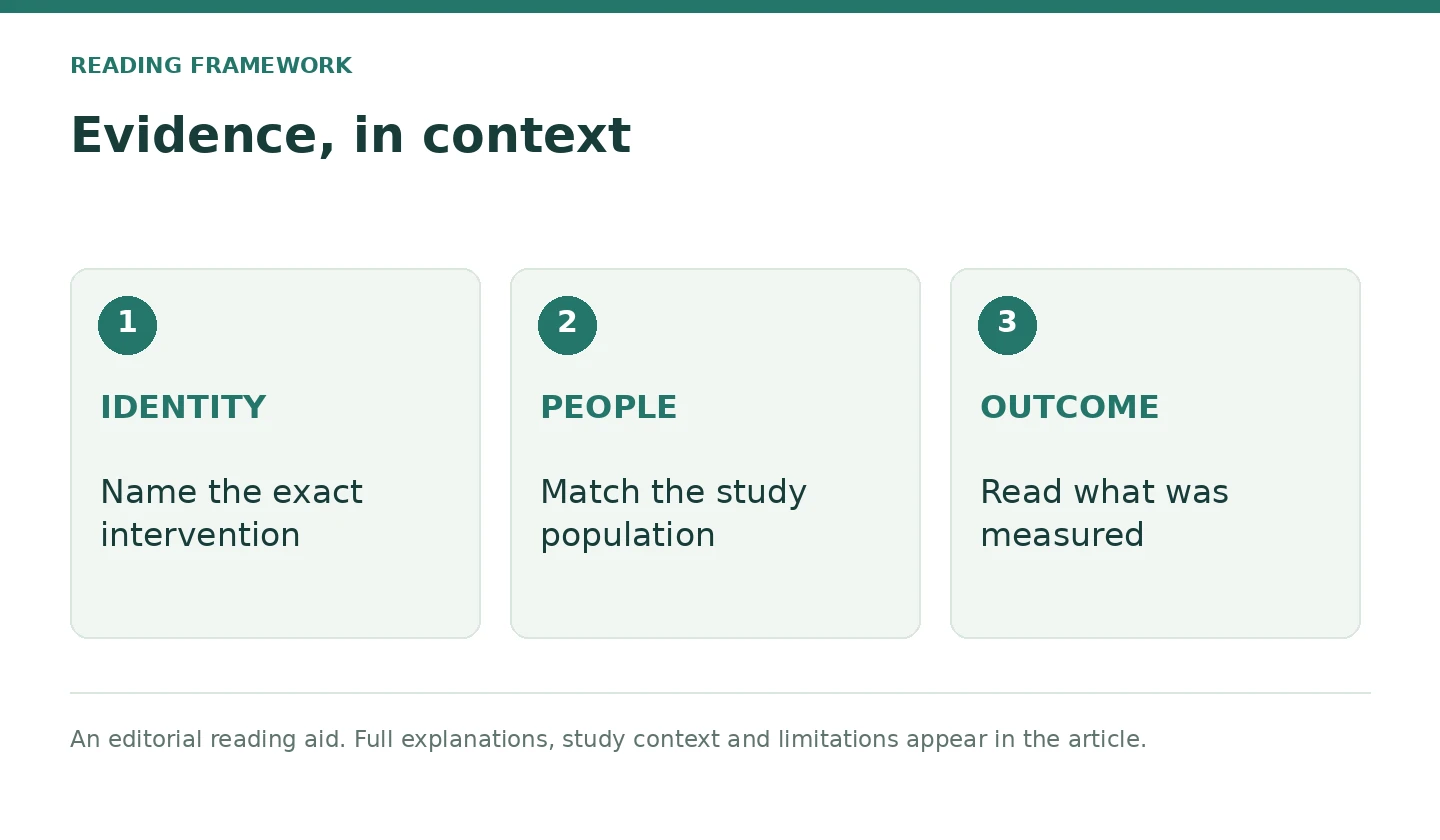
Peptide research becomes useful when you can connect a named substance to a specific study, a defined population, and a meaningful outcome. This library organizes hormone, metabolic, neurological, recovery, and blend research around those connections. Start with the question you need answered, rather than treating every product described as a peptide as part of one interchangeable treatment category.
On this page
Start with the research question
A search for peptides can lead to prescription medicines, experimental compounds, cosmetic ingredients, branded mixtures, and chemicals that are not peptides at all. A useful guide should first establish which of those is being discussed. The word peptide identifies a broad chemical class; it does not establish a medical indication, product quality, or a suitable use.
Consider the difference between asking whether a substance changes a laboratory marker and asking whether it improves strength. Those questions require different measurements. A person interested in rehabilitation also needs to know whether a study assessed pain, daily function, imaging, or return to activity. A positive answer to one cannot simply replace the answer to another.
The library therefore groups articles by the task they help you complete: identify a compound, understand measured benefits, compare alternatives, examine a study regimen, or evaluate product documentation. The main guides introduce the subject; focused articles supply the detail that would otherwise make an overview difficult to use.
Choose the section that matches your question
| Research area | Start with | Main distinction to keep visible |
|---|---|---|
| Hormones and body composition | Sermorelin, tesamorelin, CJC-1295/ipamorelin, ipamorelin | A hormone response is not automatically a strength or fat-loss result |
| Metabolism and exercise | MOTS-c, AOD-9604, retatrutide | Natural biology, animal experiments, and treatment trials answer different questions |
| Neurological recovery | Cerebrolysin and related comparisons | A result in a defined patient group is not a general cognitive-enhancement claim |
| Recovery and skin | BPC-157 and GHK-Cu | The tissue, route, and outcome must match the claim |
| Named blends | Wolverine, GLOW, KLOW | Ingredient evidence and finished-mixture evidence are different |
| Quality and access | Cerebrolysin and MOTS-c product-information guides | Identity, supply, and testing do not replace evidence of clinical benefit |
The sermorelin guide, tesamorelin guide, and CJC-1295/ipamorelin guide establish the hormone section. As the library develops, each guide connects to the relevant comparison and evidence articles. You do not need to read the entire library before finding a useful answer.
For more specialized questions, the kisspeptin review examines hormonal and sexual-function research, while hexarelin versus ipamorelin compares two commonly associated compound names. The epithalon review examines the gap between aging claims and the models used in the research. These are separate reading paths, not recommendations to combine the subjects.
Read the original study at the right level
Begin with the study’s design, not its conclusion. Ask who took part, what they received, what the comparison group received, and which outcome was chosen in advance. Then look at the size and duration of the difference and how adverse events and missing observations were handled.
A simple reading record can contain six fields: exact intervention, participants, comparison, endpoint, follow-up, and uncertainty. This makes it harder to mistake a small mechanistic experiment for a large treatment trial. It also makes comparisons much faster because the same information is collected from each source.
Biomarkers can be valuable without answering every practical question. FDA’s description of surrogate endpoints makes their use dependent on a defined context. Our practical rule is to retain the name of the actual measurement in the conclusion. If a study measured a hormone level, describe a hormone-level result before discussing what it might mean for daily life.
Product identity is part of the evidence
Two items can share a familiar name while differing in sequence, formulation, route, or mixture composition. This is particularly important for CJC labels and for names such as GLOW or Wolverine. A product heading alone is too little information to match a laboratory report or a paper.
Keep a separate record of the material in the study and the item under consideration. Record each ingredient, its amount, the presentation, and any identifying documentation. Where there is a difference, explain it instead of silently carrying the findings across. The comparison can still be informative, but the uncertainty should remain visible.
An image of a vial is not a chemical identification test. Likewise, a certificate with a high purity percentage does not by itself answer questions about the amount present, sterility, or benefit in a person. Those are separate questions requiring separate measurements and, for clinical outcomes, appropriate trials.
Read benefit and safety together
A persuasive benefit claim can make a safety paragraph seem secondary. It should not be. The same participant selection and follow-up that shape the benefit result also shape what can be learned about harm. Small or short studies can miss uncommon or delayed problems even when investigators describe treatment as well tolerated.
FDA’s substance-specific compounding safety resource identifies unresolved characterization and safety concerns for several compounds discussed in this library. It is a source to consult for the exact substance, not a reason to assume that every peptide has the same risk profile.
The side-effect comparison guide explains how to read risk claims across this library. The articles use evidence-specific language: a reported event, an observed association, a controlled difference, or an unanswered question. These terms are intentionally different. For a health decision, the next step is discussion with an appropriately qualified professional who can consider the individual situation, rather than choosing a compound from a generic ranking.
Use the library without turning it into a protocol
The dosage articles explain product instructions and published research methods. They are not personalized regimens. Trial eligibility, treatment monitoring, and the exact formulation are part of a protocol; copying only a number removes the safeguards and the context that made the experiment interpretable.
Before-and-after articles also require care. A photograph, a testimonial, and a controlled clinical outcome are not equivalent forms of evidence. The results guides explain what was measured and when, without inventing patient transformations or predicting an individual response.
A productive next step is to write down one unresolved question and follow the article that addresses it. For example, move from a compound overview to its comparison page when choosing what to research next, or to the product-identity guide when a label is unclear. That is more useful than collecting more names without resolving the first question.
Questions readers often ask
Does a registered clinical trial prove that a peptide works?
No. A registration describes a planned or ongoing study and its recorded status. Results and the final methods are needed to judge what happened. A record marked completed does not automatically provide published efficacy data.
Are all the substances in this library approved medicines?
No. The library includes different kinds of evidence and products. Product-specific indication and availability information must be checked in the relevant jurisdiction; a familiar ingredient name is not proof of approval for a particular use.
Is a comparison page a recommendation to combine the compounds?
No. A comparison clarifies differences. A mixture needs its own identification and evidence, including information about the combination rather than assumptions based on its ingredients.
Research checked 12 November 2026. Educational material; not individualized medical advice. Product information and regulatory status should be rechecked before publication.