
At a glance
Sermorelin is a growth hormone-releasing hormone analogue, commonly identified as GHRH-(1-29)-amide. Its research history includes studies of hormone responses and selected outcomes in older adults. That makes it a legitimate subject for investigation, but it does not turn every claim about muscle, sleep, fat loss, or aging into a demonstrated benefit.
On this page
What sermorelin is intended to signal
Sermorelin is discussed as a way of stimulating growth hormone release rather than supplying growth hormone itself. That distinction matters when evaluating a claim: the response depends on the biological system being stimulated. A product described as encouraging a natural pathway is still an intervention, and the word natural does not settle effectiveness or safety.
The first practical question is identity. Research papers may refer to GHRH, GHRH-(1-29), an amidated preparation, or another modified analogue. Similar terminology can conceal a different intervention. Read the methods before attaching a paper to a commercial description of sermorelin.
The 1992 GHRH-(1-29) study in older men measured GH and IGF-I responses during short treatment periods. It supports discussion of endocrine activity in that experiment. It was not a demonstration of a modern bodybuilding program, sustained weight-loss service, or long-term anti-aging outcome.
The outcomes that matter depend on the claim
A blood marker can help explain how a compound acts. It cannot automatically replace a result such as stronger muscles, better mobility, or improved daily function. A careful sermorelin article should identify the promised benefit and then locate a study that actually measured it.
| Claim being evaluated | Useful measurement | What would leave the question unresolved |
|---|---|---|
| Increased hormone activity | Timed GH measurements and IGF-I | A single untimed blood draw without a comparison |
| Muscle growth | Valid body-composition assessment plus strength/function | Hormone changes alone |
| Improved recovery | A defined injury population and functional follow-up | General wellness testimonials |
| Better cognition | Prespecified cognitive tests and relevant participants | A statement about brain health without an endpoint |
| Better sleep | A defined sleep measure and an appropriate comparator | Assuming a nighttime regimen must improve sleep |
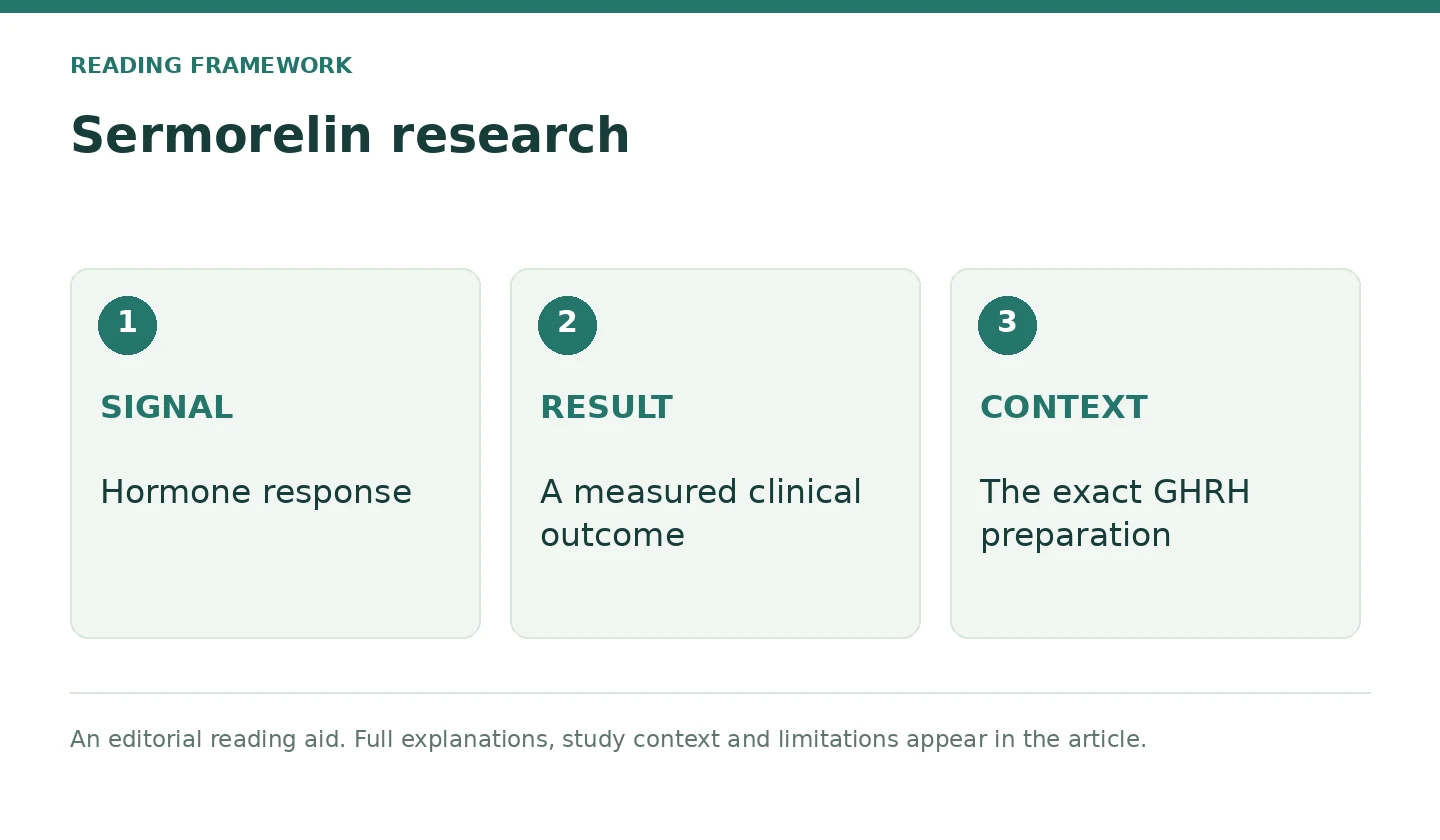
This framework does not dismiss a promising biological signal. It keeps the signal attached to the question it can answer. It also makes a consultation more productive: instead of asking whether sermorelin is good, ask which outcome is being targeted and how progress would be measured.
What the human research can contribute
The 2006 placebo-controlled GHRH study in 89 older adults examined cognitive outcomes over six months. Its population and test-based outcomes are relevant to reading cognitive claims. They do not establish effects in every age group or support a guarantee of improved everyday productivity.
When comparing this research with an offer, look at the exact intervention, participant selection, duration, and assessment method. A study involving healthy older adults has a different purpose from a trial in a diagnosed disease group. Neither can be reduced to a sentence promising that all users will feel younger.
Research can be encouraging and still leave important questions open. The size of a study affects precision; its length limits what can be learned about durability; and its outcome choice determines whether a reported change matters for the user’s goal. These are reasons to interpret results carefully rather than to ignore them.
Sermorelin and body composition
Body composition is not a single measurement. A change in body weight, lean mass, visceral fat, or muscle strength can point to different things. Even a favorable measurement does not identify the exact contribution of training, nutrition, changes in other medicines, or the intervention unless the design separates them.
A before-and-after photograph is particularly limited. It cannot identify the tissue responsible for a change or confirm which intervention caused it. A useful progress discussion starts with a baseline, a repeatable measure, and an agreed time for reassessment. For a clinical service, it also requires a plan for monitoring tolerability and deciding when treatment should be reconsidered.
Our sermorelin benefits review takes the outcome-by-outcome approach further. The sermorelin versus tesamorelin comparison explains why compounds described as related should not inherit one another’s results.
How to compare an actual offer
A product-only listing and a clinician-led service are not the same offer. One may quote an amount of material; another may include assessment, dispensing, follow-up, and laboratory work. Comparing the headline price without understanding the contents can obscure both value and important missing information.
Request the exact product identity, the intended use, the dispensing route where relevant, and the boundaries of the service. Ask who reviews baseline findings, which changes are monitored, and how questions or adverse effects are handled. A high purity figure on a report does not answer those clinical-service questions.
Treat claims of guaranteed muscle gain, universal sleep improvement, or a standard anti-aging effect as questions to verify, not as established properties of the name. A useful provider should be able to identify the evidence and explain its limitations without substituting testimonials for results.
Where this guide fits in the research library
Sermorelin sits within a wider group of hormone-related research subjects, but that does not make the group interchangeable. Long-acting CJC-1295 studies, ipamorelin experiments, and tesamorelin treatment trials have different designs and purposes. Comparing them requires more than comparing receptor pathways.
The next question is often about evidence for a specific goal. Begin there before looking for a dose chart. A schedule copied from another compound or a different formulation can appear precise while being scientifically ungrounded. The research-dose guide explains how to read those distinctions without turning study methods into personal instructions.
Frequently asked questions
Is sermorelin the same as growth hormone?
No. The distinction between stimulating a pathway and supplying a hormone is fundamental to interpreting the research. It does not, by itself, establish that one approach is safer or more effective for a particular person.
Do increases in IGF-I prove muscle growth?
No. IGF-I is a laboratory measurement. A muscle-growth claim needs relevant body-composition and functional outcomes, interpreted in the population actually studied.
What is the most useful question before comparing services?
Ask what outcome the service is trying to improve, which evidence supports that aim, and how it will be measured and monitored. Those answers are more informative than a generic description of optimization.
Research checked 12 November 2026. Educational material; not individualized medical advice. Product information and regulatory status should be rechecked before publication.