
At a glance
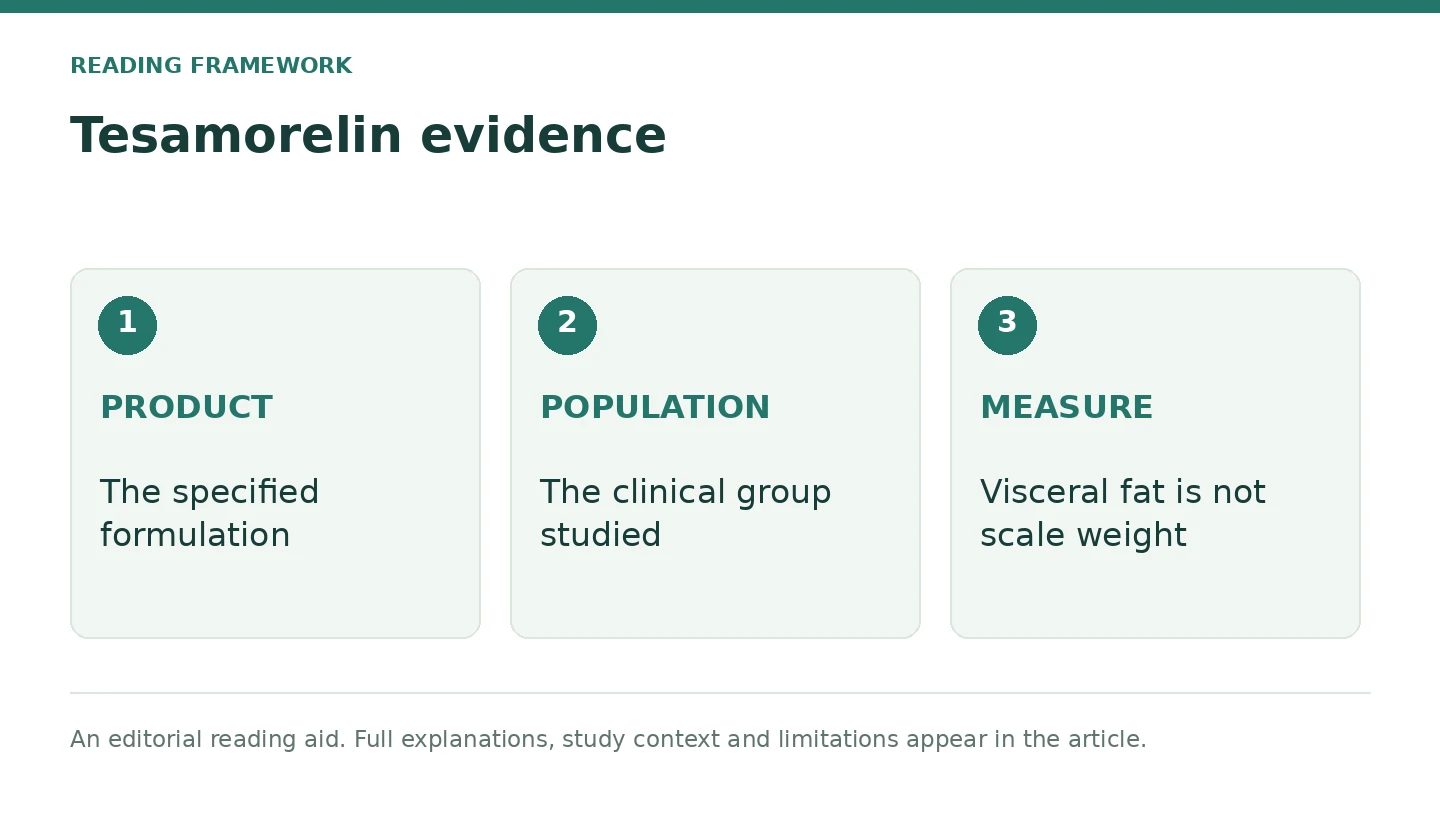
Tesamorelin has a specific clinical research and product history centered on excess visceral abdominal fat in adults with HIV-associated lipodystrophy. Its evidence should be read in that setting before being applied to general belly-fat, weight-loss, or muscle-growth claims. The relevant outcome is not simply the number on a bathroom scale.
On this page
Identify the product and the studied population
Tesamorelin is a growth hormone-releasing factor analogue. However, knowing its pharmacological family is only the start of the evaluation. Clinical trials studied selected participants, particular formulations, and defined outcomes. An ingredient label used elsewhere does not automatically represent the medicine studied.
The 2007 randomized trial enrolled 412 adults with HIV and abdominal fat accumulation and assessed changes over 26 weeks. Visceral adipose tissue decreased by 15.2% in the tesamorelin group and increased by 5.0% with placebo. Those are visceral-fat measurements, not percentages of total body weight lost.
The practical reading rule is to keep the noun next to the number. A statement about visceral fat should remain a statement about visceral fat. Removing that detail can turn a meaningful clinical finding into a misleading weight-loss advertisement.
Visceral fat, subcutaneous fat, and weight are different
Visceral fat is fat within the abdominal cavity. Subcutaneous fat is beneath the skin. A photograph of the abdomen does not reliably separate the two, and total body weight includes tissues and fluid beyond either fat compartment.
| Measurement | What it can describe | What it cannot establish on its own |
|---|---|---|
| Imaging-based visceral-fat assessment | Change in a defined abdominal fat compartment | Total-body weight loss or visible appearance for every individual |
| Waist circumference | Change around the waist | Which tissues caused that change |
| Body weight | Overall mass change | Whether fat, muscle, or fluid changed |
| Strength testing | Performance on a defined task | The anatomical source of all body-composition changes |
| Patient-reported body image | The participant’s experience | A direct measurement of visceral fat |
This is why a person can see a meaningful imaging change without a dramatic scale change. It is also why a fitness comparison based only on the largest before-and-after percentage may compare unlike outcomes.
What the prescribing information adds
The EGRIFTA WR prescribing information identifies reduction of excess abdominal fat in adults with HIV-associated lipodystrophy as the indication and states that it is not indicated for weight-loss management. It also describes monitoring and risks, including glucose intolerance and elevated IGF-I.
A product label contributes something a research abstract cannot: instructions and limitations for that particular marketed formulation. It should not be replaced by a dose quoted from an older paper. Different presentations can have different preparation and handling requirements, even when the active ingredient name is familiar.
The label is also not evidence for every other use mentioned online. An adult seeking a treatment for a different condition needs a separate evaluation of relevance and alternatives. The appropriate discussion is about the actual diagnosis and goal, not whether a product is frequently grouped with other peptides.
How to read the benefit claim fairly
A strong summary reports the population, comparison, outcome, and time point together. It also considers what happened to participants who stopped or did not complete the regimen. A result in people who remained on treatment and a result across everyone randomized can answer different questions.
For a practical decision, consider both the amount of change and how it was measured. A percentage relative to baseline is not the same as a difference from placebo. A baseline measurement is needed to interpret the scale of an individual change, and an average does not describe the full range of responses.
Our tesamorelin results guide explains those measurement issues in more detail. It avoids presenting a group average as an individual before-and-after promise.
Tesamorelin compared with other compounds
Sermorelin and tesamorelin are often discussed together because both relate to growth hormone signaling. That shared context does not establish identical exposure, evidence, or treatment uses. AOD-9604 raises another comparison entirely: its research questions and product history differ from those of a growth hormone-releasing factor analogue.
A useful comparison should therefore begin with the outcome. Is the question about visceral abdominal fat, general weight management, laboratory hormone responses, or muscle performance? Once that is clear, the studies can be compared on the relevant dimension rather than placed in a generic strongest-peptide ranking.
Use the sermorelin comparison for the hormone-related distinction and the AOD-9604 comparison for the body-composition question. Neither article is a recommendation to combine the substances.
What to ask about a product or service
Ask for the exact formulation, current prescribing information where applicable, and an explanation of the proposed use. A clinical service should identify the professional responsible for assessment and follow-up. The product should be traceable through the relevant licensed supply route rather than justified solely by a laboratory certificate.
Cost comparisons also need a consistent unit. A package price, a month’s complete service, and a quoted amount of raw material are not equivalent. Include consultation, testing, dispensing, and follow-up when evaluating the actual offer. Do not infer a treatment course from a container total.
The tesamorelin product-information guide provides a structured checklist. It focuses on product identity and documentation rather than ranking sellers or supplying a self-treatment protocol.
Frequently asked questions
Is a visceral-fat result a weight-loss result?
It is a body-composition result involving a particular fat compartment. It should not be restated as the same percentage of total weight loss.
Can another tesamorelin product use the same instructions?
The instructions must match the exact formulation and current label. An older paper or a different presentation is not a reliable substitute.
Does the evidence prove an effect on muscle growth?
A visceral-fat study does not answer that question by itself. Muscle growth, strength, and function need their own relevant measurements.
Research checked 12 November 2026. Educational material; not individualized medical advice. Product information and regulatory status should be rechecked before publication.