
At a glance
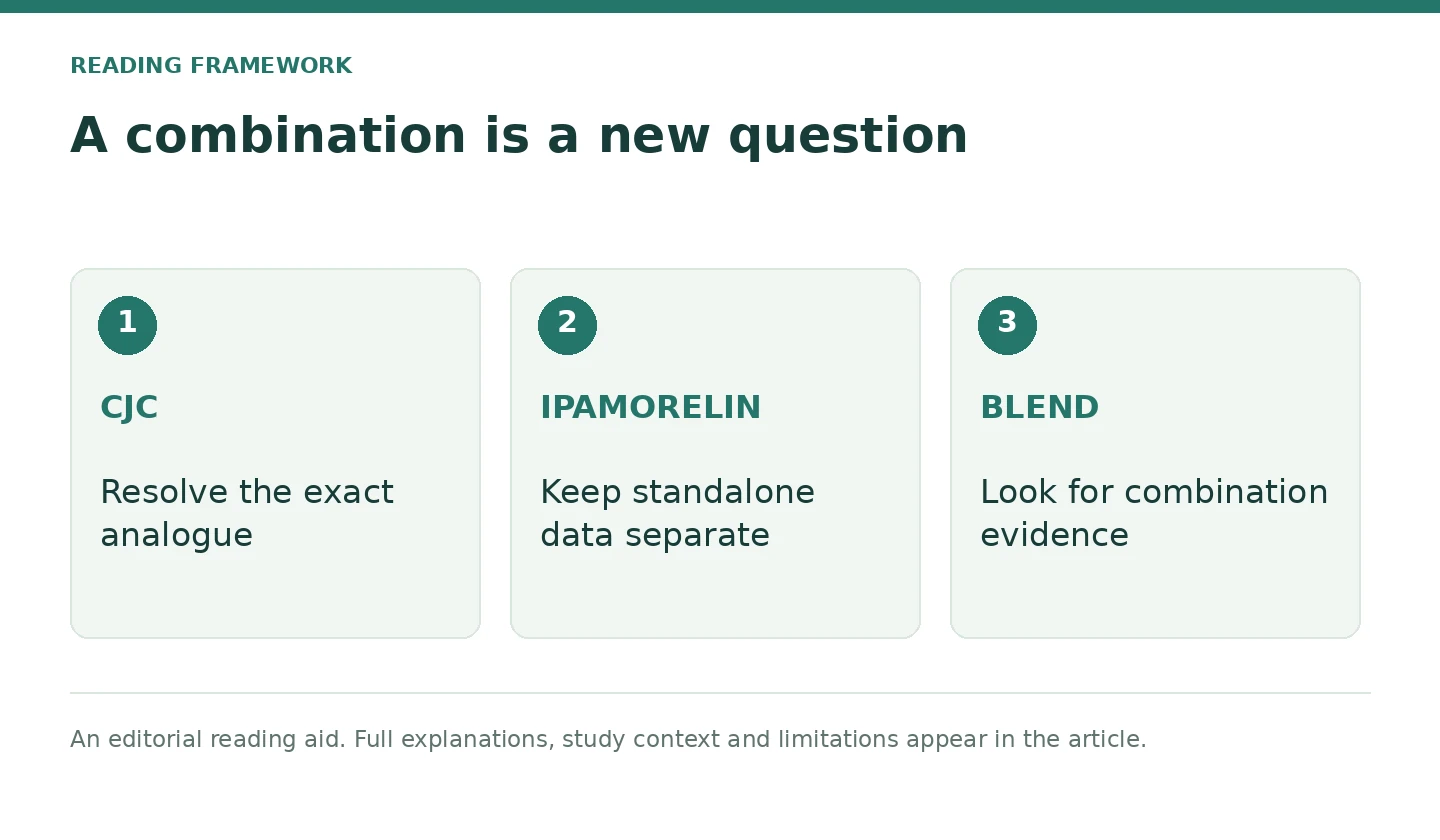
CJC-1295/ipamorelin is a combination label, not a single standardized intervention. The essential questions are which CJC preparation is present, how much of each ingredient is included, and whether the exact combination has been studied for the claimed outcome. Research on the ingredients provides context, but it cannot automatically validate a mixed product or a bodybuilding protocol.
On this page
Two ingredients, several identity questions
CJC-1295 is commonly discussed as a growth hormone-releasing hormone analogue, while ipamorelin is a growth hormone secretagogue acting through a different receptor system. That explains the biological interest in combining them. It does not establish the best formulation, a predictable benefit, or a safe schedule for every setting.
The CJC part requires particular care. Online labels use with-DAC, without-DAC, modified GRF, and shortened names inconsistently. A long-acting CJC-1295 trial cannot be attached to every item carrying the letters CJC. The exact substance and formulation should be identified before comparing timing or results.
Our DAC versus no-DAC guide addresses this naming problem directly. It is an identity question before it is a dosage question.
What the CJC-1295 trial measured
The 2006 CJC-1295 trials in healthy adults assessed pharmacokinetics and GH/IGF-I responses to a long-acting analogue. The reported half-life was measured in days. That evidence characterizes the studied intervention; it does not establish a muscle-growth effect for a different CJC product mixed with ipamorelin.
The distinction between exposure and benefit is central. A longer-lasting signal is a pharmacological property. Whether it is useful depends on the clinical objective, participant selection, monitoring, and the outcome that actually matters. Duration alone is not a ranking of treatment quality.
Do not reduce the paper to a dosing interval copied into a calculator. The rest of the methods determine what that interval meant. A numerical match between a label and a study is insufficient when the underlying material differs.
What ipamorelin research contributes
A human ipamorelin pharmacokinetic-pharmacodynamic study examined concentration and GH-response relationships. This is valuable ingredient-specific work, but the experiment should not be represented as a trial of a retail CJC/ipamorelin mixture or a training program.
This separation gives readers a more accurate evidence map. One group of studies can explain an ingredient’s hormonal activity. A different study would be needed to establish whether combining it with another compound improves a meaningful outcome, and another may be required to characterize long-term effects in a different population.
A proposed mechanism is a reason to investigate a combination, not a completed test of it. The same standard should apply even when a combination is familiar or widely discussed.
The evidence questions for a combination
| Question | Evidence that would help | Common shortcut to avoid |
|---|---|---|
| What is in the product? | Exact ingredient identities and amounts | Treating a blend name as a complete specification |
| Does the combination add benefit? | Appropriate ingredient and combination comparison groups | Assuming two active ingredients must work better together |
| Is a muscle claim supported? | Relevant body-composition and strength outcomes | Substituting hormone changes for muscle measurements |
| Does the schedule match the evidence? | The same formulation, route, and study population | Applying a long-acting study to an unidentified no-DAC item |
| Is safety characterized? | Adverse-event collection, follow-up, and product quality data | Treating absence of complaints as evidence of safety |
The most useful comparison would specify a goal before selecting outcomes. Otherwise, positive findings from unrelated experiments can be assembled into a persuasive narrative without ever testing the commercial claim.
Why blend ratios and container totals matter
A total amount on the front of a container does not show how much of each component is present. Two mixtures can contain the same total mass and very different ingredient proportions. A report identifying one component also does not establish the amount of the other.
The paperwork should identify each ingredient, the total and per-component amounts, the formulation, and the lot being assessed. These are identity and quality questions; resolving them still does not prove clinical benefit. They are nevertheless necessary before the product can be meaningfully compared with anything else.
For this reason, a pen-versus-vial comparison should begin with specifications rather than convenience. A different presentation does not supply evidence of equivalent delivery, storage stability, or human outcomes.
How to interpret benefits and results claims
For a muscle-growth claim, ask whether the source measured muscle size, lean mass, strength, or training performance. These are not synonyms. Lean mass includes more than contractile muscle, and a photograph cannot reliably explain which tissue changed.
For recovery claims, identify the injury or condition and the measure of improvement. Feeling different during a training block can be worth discussing, but it does not isolate the contribution of a compound from sleep, exercise, nutrition, or other changes. A controlled design is needed to separate those explanations.
The sermorelin comparison and research-dose discussion address common next questions. They help readers compare the evidence without treating forum protocols as established instructions.
Questions readers often ask
Does using two pathways prove synergy?
No. Biological plausibility is not the same as a demonstrated additional benefit. The exact combination needs an appropriate comparison and a relevant measured outcome.
Is CJC-1295 without DAC the same product as the long-acting CJC study?
Do not assume that. Resolve the exact identity from the product documentation and the paper before borrowing its exposure or scheduling information.
Can a certificate of analysis settle whether the blend works?
No. It can address only the properties actually tested in the submitted sample. Clinical effects and an individual’s suitability require different evidence and assessment.
Research checked 12 November 2026. Educational material; not individualized medical advice. Product information and regulatory status should be rechecked before publication.