
At a glance
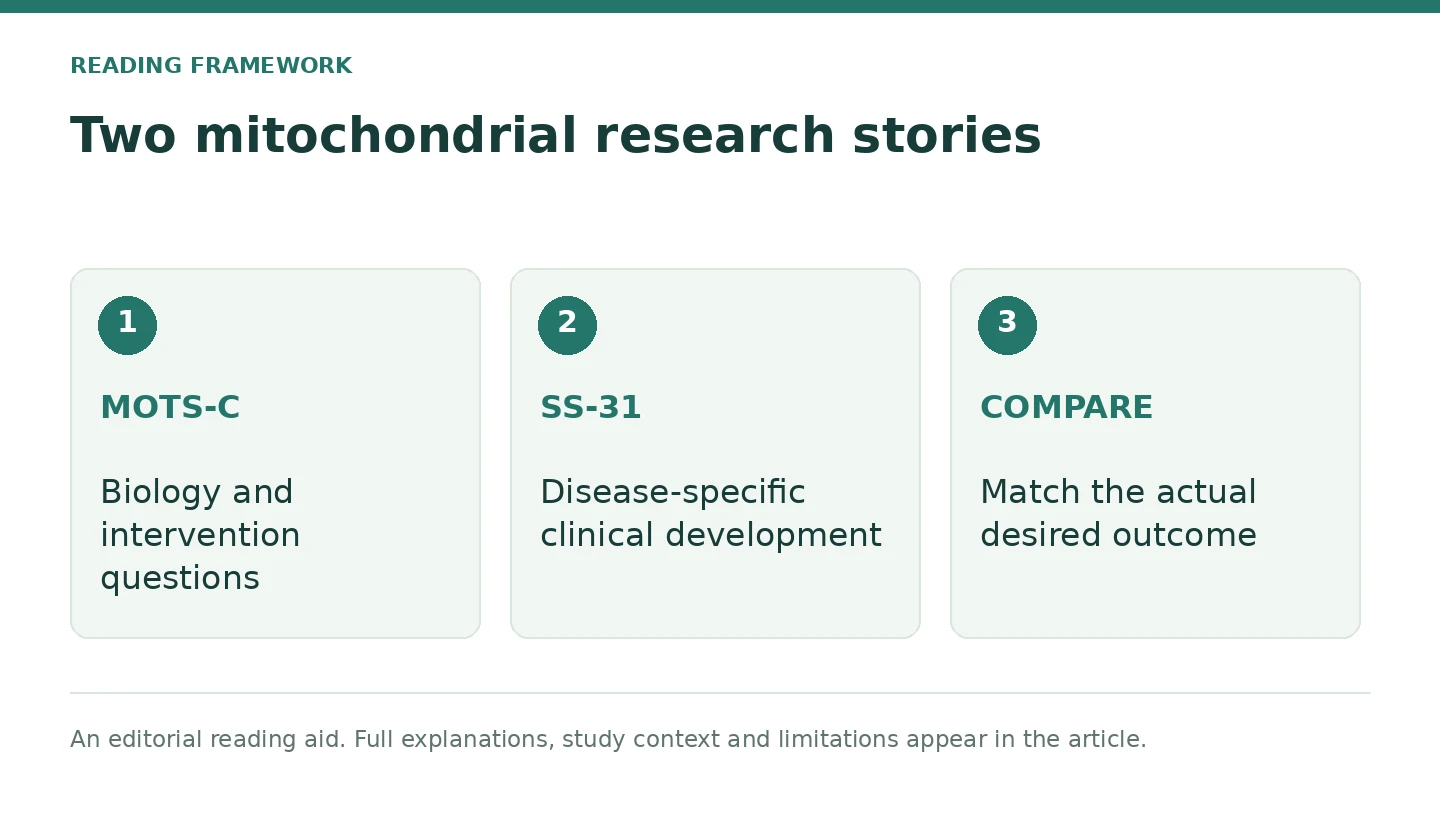
MOTS-c and SS-31 are both discussed in mitochondrial research, but that shared language does not make them equivalent. Their identities, development programs, studied populations, and outcomes differ. A useful comparison asks what each intervention has actually been shown to do in a defined setting rather than treating mitochondria as a universal energy claim.
On this page
The MOTS-c research story
MOTS-c is studied as a mitochondrial-derived peptide, including questions about cellular stress responses and metabolism. The cellular stress-signaling study provides a mechanistic example. It does not establish general energy, weight-loss, or anti-aging benefits from a consumer product.
The distinction between endogenous measurements and an administered intervention remains important. A natural biological response can motivate a treatment hypothesis without proving that supplying the peptide reproduces the same result.
The MOTS-c overview and exercise-claims guide organize those evidence categories separately.
The SS-31/elamipretide research story
SS-31 is associated with elamipretide development. The FDA Forzinity trial snapshot describes indication-specific accelerated approval for improving muscle strength in adults and pediatric patients with Barth syndrome weighing at least 30 kg. That is a specific clinical product and population, not a general anti-aging endorsement.
The existence of an approved product does not establish that every SS-31-labeled listing is equivalent to it. Product identity, formulation, manufacturing, instructions, and authorized supply remain essential.
The SS-31 evidence map explains why outcomes in one condition should not be transferred automatically to other mitochondrial disorders or to healthy adults.
What the comparison should preserve
| Dimension | MOTS-c | SS-31/elamipretide |
|---|---|---|
| Starting identity question | Parent peptide, endogenous measurement, or modified analogue? | Exact elamipretide product or another SS-31-labeled material? |
| Research emphasis in this guide | Cellular signaling and translation to intervention questions | Disease-specific development and clinical outcomes |
| Common overstatement | A mechanism proves everyday energy improvement | A specific approval proves general wellness benefit |
| Product-evidence gap | Retail product not automatically matched to research | Research listing not automatically equivalent to the approved product |
| Useful next question | Which human intervention measured the desired outcome? | Does the clinical evidence apply to this condition and product? |
Energy is not a single endpoint
A person may use energy to describe fatigue, endurance, strength, mood, concentration, or activity. These are different outcomes. A study should identify which one was measured and how.
A mitochondrial mechanism does not answer all of those questions. The relevant clinical evidence needs an applicable population, a defined intervention, a comparator, and meaningful follow-up.
The biomarker guide explains why biological plausibility should remain separate from demonstrated clinical benefit. A detailed mechanism can be impressive without settling the practical question.
Why there is no universal winner
A compound can have more developed evidence for a specific disease while remaining unproven for another purpose. A second compound can have interesting preclinical findings without being ready for the same clinical conclusion.
Ranking the two using general terms such as stronger or better for mitochondria conceals those differences. The sensible comparison begins with a clearly defined clinical or research question.
A person with unexplained fatigue, for example, needs an appropriate assessment rather than an assumption that a mitochondrial product is the answer. The cause and available care may be unrelated to either compound.
Product and clinical evidence should stay separate
A batch report describes particular analytical testing. It does not establish a disease indication, clinical benefit, or a personal regimen. Conversely, an approved product’s evidence does not authenticate an unrelated product bearing a research name.
The MOTS-c product-document guide provides a practical verification framework. The same principle applies to SS-31 listings: identify the material and source rather than borrowing the credibility of a clinical development program.
This guide does not recommend combining the compounds. Two distinct research rationales do not establish safety or effectiveness for their concurrent use.
How to follow future evidence
Track the exact intervention, participant group, prespecified outcomes, and publication status. Distinguish a registered plan from posted results and a peer-reviewed report. When a new study appears, ask which uncertainty it actually resolves.
A useful library update changes the relevant conclusion rather than simply adding a new paper to a list. If the study concerns a different analogue or population, label it as related evidence instead of silently extending an existing claim.
That approach supports broad coverage without treating every mitochondrial topic as the same commercial story.
Frequently asked questions
Does shared mitochondrial research make MOTS-c and SS-31 interchangeable?
No. They have different identities and evidence programs. Similar thematic language does not establish equivalent effects, products, or regimens.
Does an indication-specific approval establish benefits in healthy adults?
No. The product, population, and indication are part of the evidence. Broader claims require their own support.
Is there evidence here for using both together?
This comparison does not establish a combination regimen. Separate research programs do not validate concurrent use or demonstrate additive benefit.
Research checked 12 November 2026. Educational material; not individualized medical advice. Product information and regulatory status should be rechecked before publication.